
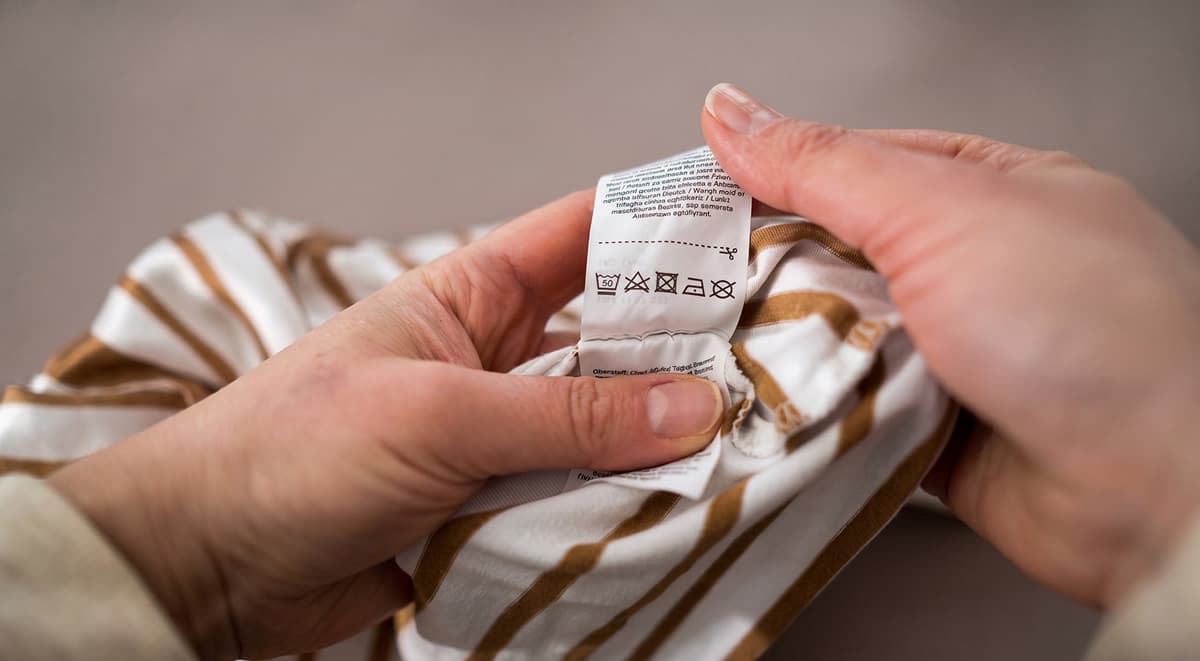
Most new brands spend weeks perfecting their logo, choosing the right font, and debating ribbon versus string on their hang tag. All of that matters. But the two labels sewn into and attached to every garment you sell go far beyond branding. Get either one wrong, and your product can’t legally reach the customer at all.
Every garment you sell carries two labels, and both of them matter more than most new brands realise. One is a legal requirement. Get it wrong, and your product can’t reach the customer at all. The other is a sales tool, working for you the moment someone picks it up. In this post, we cover both: the care label, and the price tag.
Let’s have a look at the two labels at a glance.
| Care Label | Price Tag | |
|---|---|---|
| Location | Permanently sewn inside garment | Attached by string — removed at purchase |
| Legally Required | Yes, enforced by ACCC | No |
| Purpose | Legal compliance | Branding + first impression |
| When it matters | After purchase — every wash | Before purchase — at the rack |
| Who reads it | Customer, ACCC, customs | Customer |
The Care Label
It is a legal requirement under the Consumer Goods (Care Labelling) Information Standard 2023, enforced by the ACCC.
| What can go wrong, and how much it costs |
|---|
| A customer follows incorrect care instructions and ruins the garment → compensation claim |
| Label says “100% Silk” but the fabric is a blend → false declaration, illegal |
| Penalties can reach up to $1.1 million, and ACCC enforcement is published publicly |
What Every Care Label Must Include
Every care label must permanently include three key pieces of information:
- How to care for the garment – washing, drying, ironing, bleaching, dry cleaning
- What the garment is actually made of – fibre content
- Where it was manufactured – country of origin
How to use Care Instructions in Symbol Form
Since March 2024, ISO symbols alone satisfy Australian legal requirements – English text is no longer mandatory. Most premium brands include both, because many customers don’t know what the symbols mean.
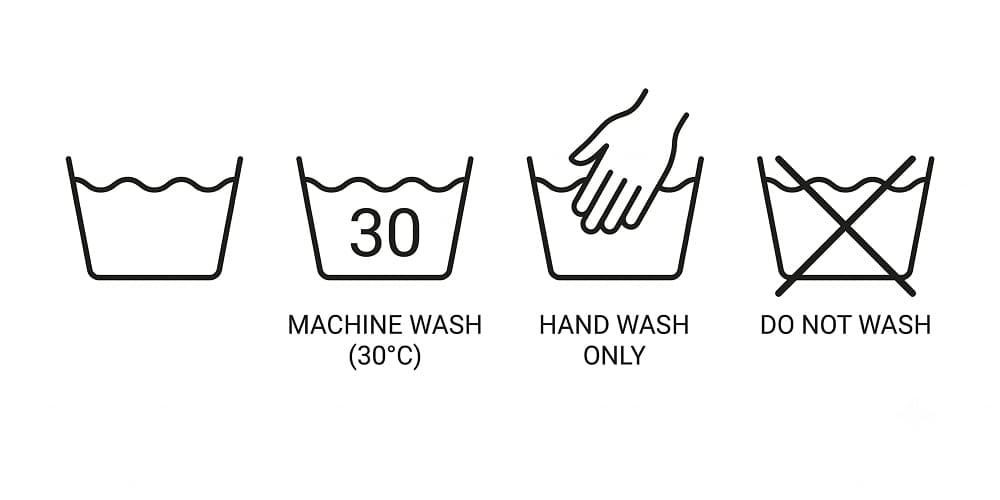
| Symbol | Meaning | Common for |
|---|---|---|
| Tub (no number) | Machine wash, any temperature | Cotton, synthetics |
| Tub with 30 | Machine wash max 30°C | Delicates, silk blends |
| Hand in tub | Hand wash only | Silk, wool, fine knits |
| Tub with X | Do not wash | Leather, structured pieces |
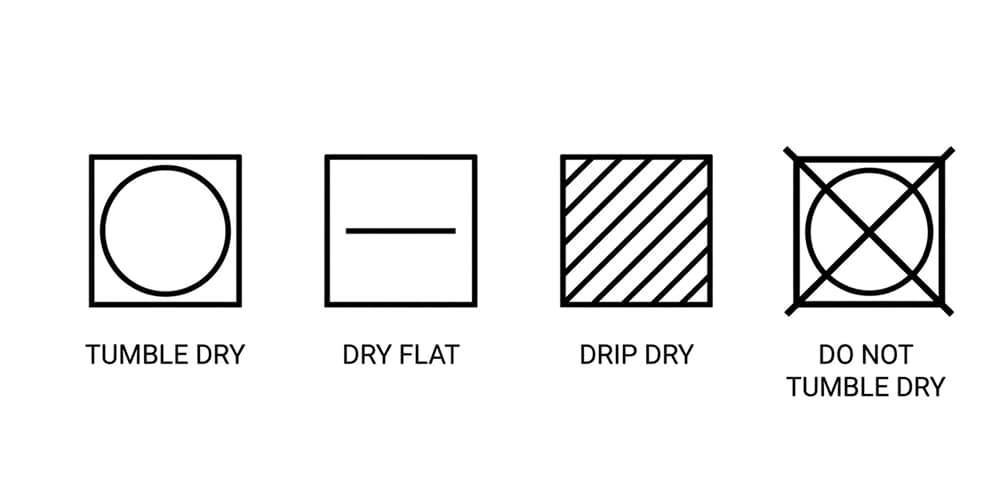
| Symbol | Meaning |
|---|---|
| Square with circle inside | Tumble dry allowed |
| Square with horizontal line | Dry flat (lay garment horizontal) |
| Square with diagonal lines | Drip dry / hang dry |
| Square with X over circle | Do not tumble dry |
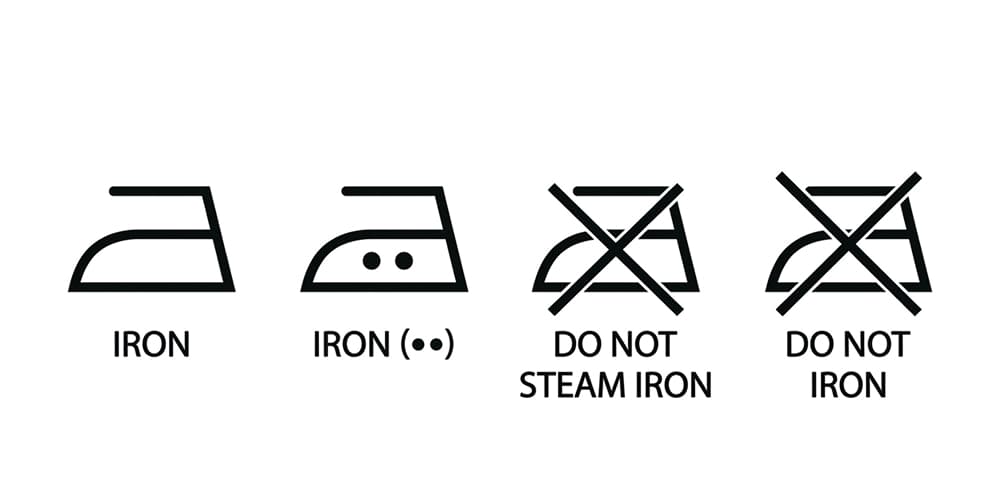
| Dots | Max Temp | Suitable Fabrics |
|---|---|---|
| • (one dot) | Up to 110°C | Synthetics (polyester, nylon) |
| •• (two dots) | Up to 150°C | Silk, Wool |
| ••• (three dots) | Up to 200°C | Cotton, Linen |
| Iron with X | Do not iron | Embellishments, prints, some blends |
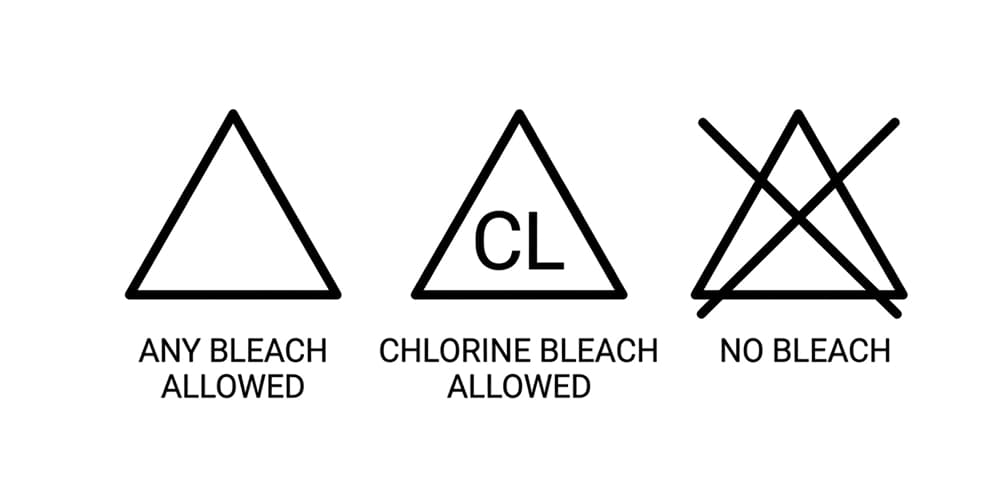
| Symbol | Meaning |
|---|---|
| Empty triangle | Any bleach allowed |
| Triangle with CL inside | Chlorine bleach allowed |
| Triangle with X | Leather, structured pieces |
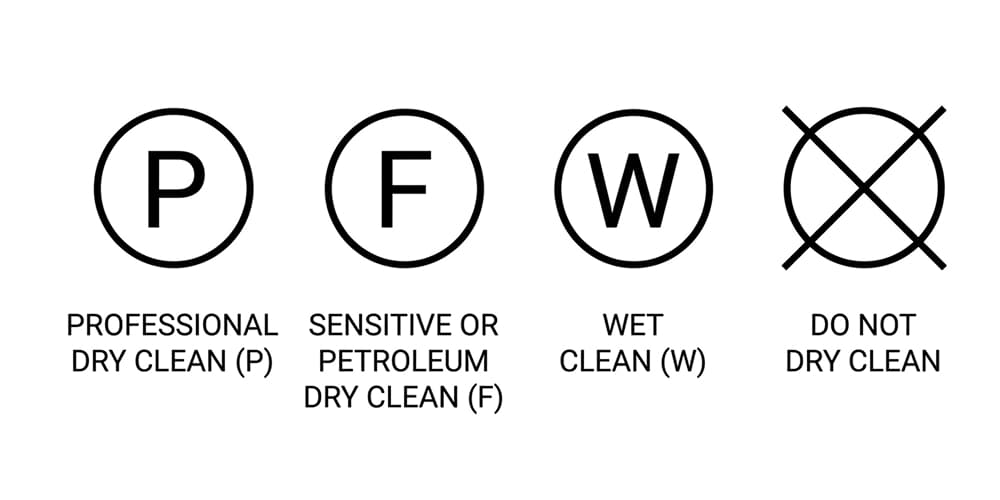
| Symbol | Meaning |
|---|---|
| P | Standard dry cleaning (most common) |
| F | Petroleum-based solvents only |
| W | Silk, wool, fine knits |
| X (cross over circle) | Do not dry clean |
Fibre Contents
Not mandatory under Australian federal law, but mandatory in New South Wales and required in the US and the EU. There is no good reason to leave it off.
| Rule | Example |
|---|---|
| List in descending order by weight | 95% Mulberry Silk, 5% Spandex |
| If lined, label each component separately | Shell: 100% Silk / Lining: 100% Polyester |
| Use generic names | “Silk”, not “Charmeuse” or “Habotai |
| Rounding to nearest 1% | 94.7% Silk = 95% Silk on label |
Country of Origin
Mandatory in Australia. State it clearly: “Made in China” or “Designed in Australia. Made in China.” Australian imagery, maps, or green and gold colour combinations used near origin claims can constitute a misleading impression, even without the words “Made in Australia.” The ACCC enforces this strictly.
Selling Globally? Here’s What Changes
If you plan to sell across multiple markets, your care label requirements change significantly. Here’s a practical comparison:
| Requirement | Australia | USA | EU |
|---|---|---|---|
| ISO symbols | Required (since Mar 2024) | Not required | Required |
| English text | No longer mandatory | Mandatory | Not required |
| Local language | Not required | English only | Language of each country |
| Fibre content | Required in NSW; best practice | Mandatory | Mandatory |
| Country of origin | Mandatory | Mandatory | Mandatory |
| RN number | Not required | Required for US companies | Not required |
| Market | What your label must say |
|---|---|
| Australia | ISO symbols + 60% Cotton, 40% Silk + Made in China |
| USA | ISO symbols + English text + 60% Cotton, 40% Silk + Made in China + RN 000000 |
| EU (e.g. France) | ISO symbols + French: 60% Coton, 40% Soie + Fabriqué en Chine |
If you’re producing for multiple markets, the cleanest approach is one woven label with all ISO symbols, English text, and fibre content. Add a separate country-specific language label where required.
Your The Rules Go Further If You’re Selling Children’s Clothing
For general children’s daywear, the care label requirements are the same as adult clothing, plus two additional layers that apply across all kidswear.
| Requirement | Detail |
|---|---|
| Drawstrings & cords | Strict length restrictions apply, different rules for hood, waist, hem |
| Chemical restrictions | Azo dyes and hazardous substance limits apply |
| Children’s nightwear (sizes 00–14) | Mandatory fire hazard label required based on flammability testing |
If you’re selling children’s nightwear (pyjamas, nightgowns, all-in-ones, sleeping bags, sizes 00–14).
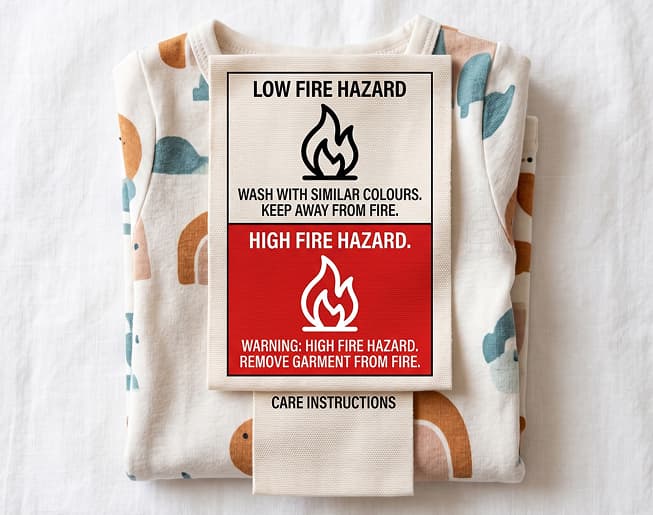
Every piece must carry a fire hazard label, white for low fire hazard, red for high fire hazard, based on mandatory flammability testing.
Selling without this label is illegal. Not subject to fine – illegal. Organic cotton is almost always classified as high fire hazard (red label). “Natural” does not mean low flammability. Cotton On Kids labelled 2,500 garments “low fire hazard.” Testing found them highly flammable. The penalty? $1,000,000.
The Price Tag
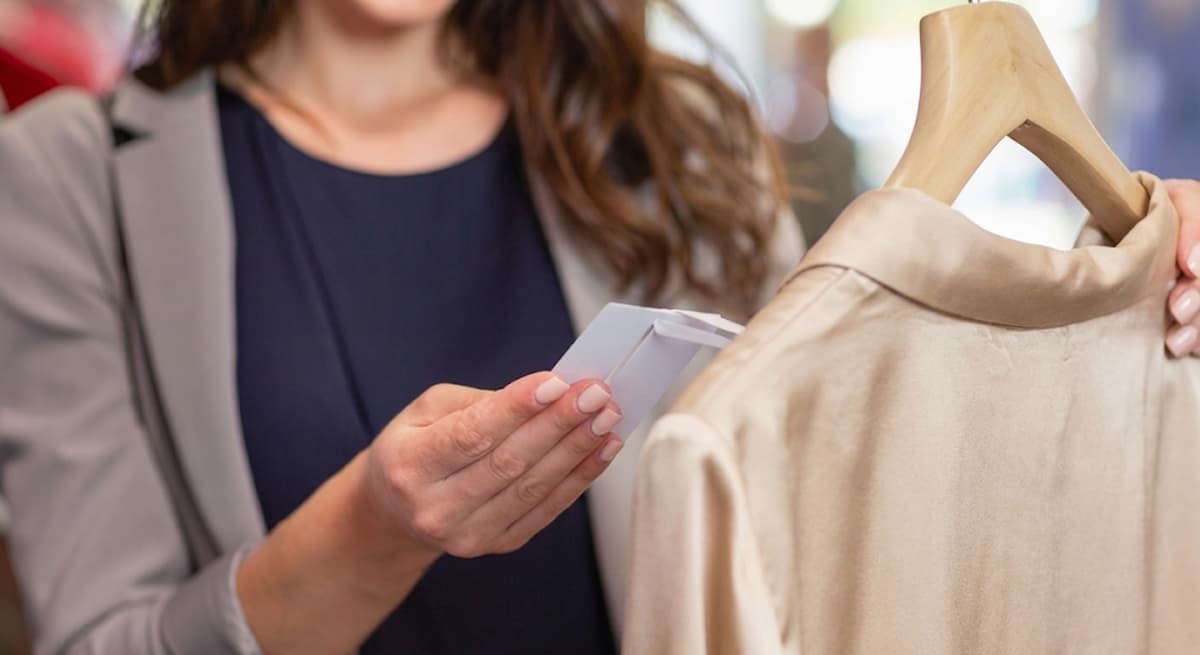
The price tag, or hang tag, is the detachable label your customer picks up before they even try the garment on. In Australia, there is no legal requirement for what it must contain. But that’s exactly what makes it valuable. Think of it as your silent salesperson. When your garment is hanging on a rack alongside ten others, the tag is doing the talking. A customer who reads “6A Mulberry Silk” before trying the garment on already has a reason to buy.
What To Put On Your Price Tag
| Item | Include | Why |
|---|---|---|
| Brand name / logo | ✓ Always | Identity, first thing they see |
| Price (incl. GST) | ✓ Always | Legal best practice in Australia |
| Size | ✓ Recommended | Core purchase decision |
| Product name | ✓ Recommended | Helps customer remember and reorder |
| Colour name | ✓ Recommended | Essential for multiple colourways |
| Material highlight | ✓ Recommended | Sells premium positioning before they try it on |
| Barcode / QR code | ✓ Recommended | Inventory management; links to online store |
| Country of origin | Optional | Adds transparency; can reinforce “designed in AU” story |
| Full fibre content | ✗ Not here | On the care label |
| Full care instructions | ✗ Not here | On the care label |
The Bottom Line
The care label is a legal document. The price tag is a sales tool.
Get the care label right from the very first sample: correct symbols, fibre content, country of origin, permanently sewn in and built to last. Then use the price tag to do what the label can’t, tell your customer why your garment is worth it.
At Passionworks, both are reviewed at the sampling stage: the care label for legal accuracy, the price tag for brand consistency. Getting them right before bulk production is part of what we do.
