
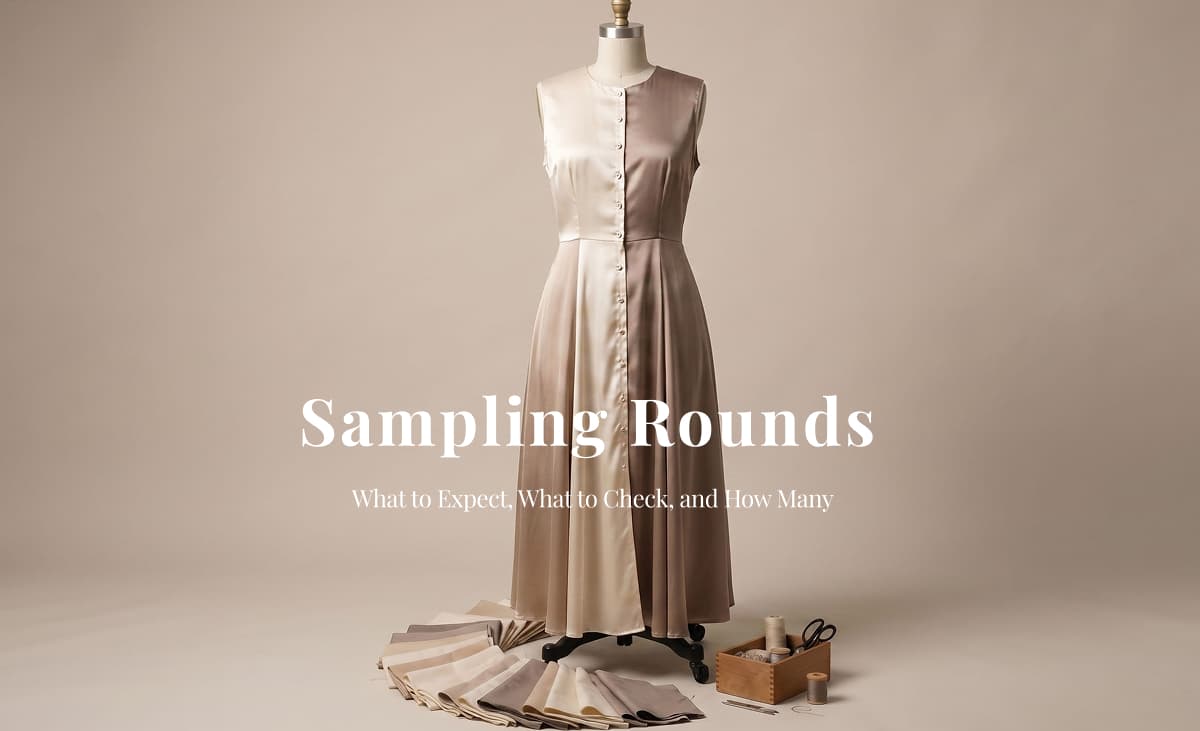
Your sample just arrived. You try it on, and something feels off.
The fabric you chose looked perfect on the swatch. But sewn into a garment, it drapes differently, sits differently, and feels different against the skin. The silhouette you imagined does not quite match what is in front of you.
And it is not the factory’s fault. The construction is fine. The stitching is clean. The problem is that fabric on a roll and fabric on a body are two completely different things, and no one warns you about that until you are holding the sample.
This is exactly what sampling rounds are for. Not to approve a perfect result on the first try, but to close the gap between what you envisioned and what actually works in real fabric, on a real body.
What Is Sampling?
Sampling is the process of making and reviewing a small number of garments before committing to bulk production. Think of it like building a prototype before a product launch. It exists to catch problems early, when they are still cheap and fast to fix.
At PassionWorks, sampling is a collaborative process. We work through each round with you, reviewing fit, fabric, and construction details together, so that nothing gets missed before production begins.
How Many Stages Are There?
The full sampling process at PassionWorks runs across five stages. For larger orders, particularly those involving multiple sizes or higher production volumes, all five stages are recommended to ensure consistency and quality across the full run.
For smaller orders, it is possible to streamline the process to three key stages: Stage 1, Stage 2, and Stage 5. This reduces both time and cost without compromising the fundamentals of fit and quality approval. Stages 3 and 4 can be reintroduced as your order volumes grow.
| Stage | Name | Small Orders | Large Orders |
|---|---|---|---|
| Stage 1 | Proto Sample | Yes | Yes |
| Stage 2 | Fit Sample | Yes | Yes |
| Stage 3 | Salesman Sample (SMS) | Yes | |
| Stage 4 | Size Set Sample | Yes | |
| Stage 5 | Pre-production Sample (PPS) | Yes | Yes |
Small orders (new brands, first productions): Stage 1 → 2 → 5
Larger orders (multiple sizes, higher volumes): Usually five stages
Whichever path you take, Stages 1, 2, and 5 are non-negotiable. These are the stages that confirm your design direction, refine the fit, and give final approval before bulk. Skipping any one of them significantly increases the risk of costly issues in production.
Each Stage Explained
STAGE 1, Proto Sample
Proto Sample
” Confirming the design direction “
The First Physical Version Of Your Design
The Proto Sample is the first physical version of your design, the moment an idea becomes something you can actually hold. The goal at this stage is not perfection. It is simply to confirm that the overall concept works.
If your final fabric has not arrived at the factory yet, a substitute may be used. The colour may also differ. This is completely normal. At this stage, fabric behaviour and finishing quality are not the focus.
What to look at:
- Does the overall silhouette match what you had in mind?
- Are the sleeve length and garment length right?
- Do the shoulder line and waistline sit where they should?
- Are the design details coming through as intended?
- Do the overall proportions feel balanced?
What to leave for later:
- Exact fabric feel and colour
- Precise fit
- Finishing quality
How to give feedback:
- Mark up photos directly with arrows and annotations, not descriptions in words alone
- Use numbers. The sleeve feels short is hard to act on. Please add 3cm to the sleeve length is not
- Always follow up in writing. Verbal feedback is easy to misinterpret, and written records protect both sides
- Use numbers. The sleeve feels short is hard to act on. Please add 3cm to the sleeve length is not
STAGE 2, Fit Sample
Fit Sample
” Getting the fit right “
Most styles require more than one fit round.
Once the design direction is confirmed, fit development begins. Fit Samples should be made in the approved fabric wherever possible. Colour is not a priority here. The focus is entirely on achieving the correct fit and pattern.
Most styles require more than one fit round. Two or three rounds of adjustments are completely normal, not a sign that something has gone wrong.
This is also the stage where the gap between swatch and garment becomes most apparent. A fabric that looked beautiful flat on a table can drape, sit, and feel entirely different once it is sewn into a garment and put on a body. If you find that the fabric is not working the way you expected, this is the right moment to reconsider, not after Stage 5.
What to look at:
- Comfort and ease of movement. Sit down, raise your arms, walk. Does anything pull or restrict?
- Fabric drape and garment flow. Does the silhouette hold when the fabric is in motion?
- Measurements. Check every key point against your spec sheet with a tape measure, and do not rely on how it looks
How to give feedback:
- Always review the sample on a body, not laid flat. A photo on a hanger or table tells you very little about fit
- Reference your spec sheet directly. The chest measurement at 1cm below the armhole should be 48cm. The sample measures 51cm is the kind of feedback a factory can act on immediately
- If you are considering a fabric change, decide now. Changing fabric after this stage means restarting fit development from the beginning
STAGE 3, Salesman Sample (SMS) / Photo Sample
Salesman Sample
” Preparing for marketing and sales “
The standard here shifts from development to presentation.
With fit fully approved, the Salesman Sample is produced for marketing, photography, buyer presentations, and sales meetings. It should closely resemble the final product in every way.
Many brands use this sample for ecommerce photography, social media campaigns, lookbooks, and wholesale presentations. The standard here shifts from development to presentation.
What to confirm:
- Correct fabric, trims, and colours are all in place
- Fit matches the final approved version
- Brand details, labels, tags, and any branded hardware are applied correctly
STAGE 4, Size Sample
Size Sample
” Scaling the approved pattern up
and down across sizes “
The production before bulk
For brands producing across a size range, a Size Set Sample is produced before bulk to verify that grading, the process of scaling the approved pattern up and down across sizes, has been done accurately.
Grading errors do not always show up when you are only looking at one size. A size set review catches inconsistencies before they become a bulk problem.
What to confirm:
- Does fit hold consistently across the full size range?
- Are measurements correct for every size against the spec?
- Does the garment work across different body types?
STAGE 5, Pre-Production Sample (PPS)
Pre-Production Sample
” Final approval before bulk production begins “
Be manufactured, every detail, every label, every trim
The PPS is the last checkpoint before the factory starts bulk production. This sample must represent exactly what will be manufactured, every detail, every label, every trim.
At PassionWorks, our QC team reviews the PPS as a finished product rather than a development sample. Workmanship, measurements, labelling, finishing, and overall presentation are all checked against the approved specifications.
Only after PPS approval should bulk production begin.
What to confirm:
- Approved bulk fabric is being used
- All trims and colours match the spec
- Construction methods match what was approved
- Main label, care label, and size label are all correct and correctly positioned
- Packaging and hangtags are applied correctly
- Seams are straight, even, and consistent throughout
- Turn the garment inside out. Raw edges, loose threads, and uneven seam finishing all indicate production qualitypes?
How Long Does Sampling Take?
The timeframes below are a general guide.
| Stage | Timeframe |
|---|---|
| Stage 1, Proto Sample | 2~3 weeks |
| Feedback and revision | 1 week |
| Stage 2, Fit Sample | 2~6 weeks |
| Feedback and revision | 1 week |
| Stage 5, PPS | 2~3 weeks |
| Final Approval | 1 week |
| Total | 9 ~ 15 weeks |
The actual duration will vary depending on the complexity of your design, the fabric selected, and any additional accessories or trims involved, such as custom buttons, embroidery, lace, or specialised hardware. More intricate styles naturally require more time at each stage to get right.
If you have a target launch date, work backwards from it to set your sampling start date, not the other way around.
The Mistakes That Cost the Most Time
Approving a sample with unresolved issues
Anything you overlook in sampling will appear in bulk. In most cases, it gets worse at scale, not better.
Here is why.
Once you approve a sample, the factory treats that approval as a green light to replicate everything in it, including the parts you were not happy with. At bulk scale, a seam that sits slightly off becomes a seam that sits off on every single unit. A collar that gaps a little becomes a collar that gaps consistently across the entire run. Fixing issues after bulk production has started means stopping the line, reworking completed garments, or in the worst case, rejecting the batch. That costs far more, in time and money, than requesting one more sample round before approval.Fixing issues after bulk production has started means stopping the line, reworking completed garments, or in the worst case, rejecting the batch. That costs far more, in time and money, than requesting one more sample round before approval.
Giving feedback verbally without a written record
“Make it a bit slimmer” means something different to every factory. Numbers and annotated photos are the only feedback that travels reliably across time zones and language differences.
Here is why.
Verbal feedback, whether given on a call or in a voice message, is interpreted by the person who receives it, translated internally, passed to the pattern maker, and acted on without any reference point. By the time it reaches the factory floor, “a bit slimmer” could mean 1cm or 4cm. Nobody is at fault. The instruction was simply too vague to survive the journey. A written record with specific measurements and marked-up photos removes interpretation from the process entirely. It also protects you if a dispute arises about what was agreed.
Reviewing the sample flat on a table
Garments are worn, not displayed. If a real person isn’t wearing it during your review, you’re missing half the information.
Here is why.
A garment behaves completely differently on a body than it does laid flat. Fabric that sits neatly on a table may pull across the shoulders when worn, gap at the chest, or lose its silhouette entirely when the wearer moves or sits down. Bias-cut styles, wrap designs, and anything with drape are particularly misleading when reviewed flat. The only way to understand how a garment truly fits, moves, and falls is to put it on a person, ideally someone within your target size range, and watch it in motion.
Final Thought
Sampling is not the slow part of production. It’s the part that makes the rest of it fast. Brands that invest time in thorough sampling rarely have bulk quality issues. Brands that rush it almost always do. And there’s one thing that no photo, video call, or written spec can fully replace, and that is seeing it in person and trying it on yourself.
At PassionWorks, you’re welcome to come in and do exactly that. Feel the fabric. Put the sample on. Walk in it, sit in it, move in it. Because the moment you wear it, you’ll know things no flatlay photo could ever tell you.
If you’re unsure what to look for at any stage, or how to structure your feedback, we work through every sample round with you, so nothing gets missed before bulk begins.
