


You approved the sample. You sent the specs. You waited. Then the order arrives, and something is wrong. The colour is off. The sizing is inconsistent across units. A trim has been swapped without a word. Nobody told you. Nobody asked.
Why Factory Make Unauthorised Changes
Understanding why this happens does not excuse it, but it helps you prevent it.
The sample team and the production team are different people.
Your sample was made by a skilled sample maker who read your specs carefully. Bulk production runs on a line where speed matters. Details get lost in handover.
“Close enough” is a factory judgement call.
A slightly different shade looks passable under a factory floor light. A few centimetres of size difference might sit within what a factory considers acceptable, even when it clearly is not. Without a written tolerance clause, they have room to argue.
Communication stops after the sample is approved.
Once you sign off on the sample, many factories treat that as the end of the conversation. Changes made during bulk production often go unreported until the goods are in your hands.
Subcontractors introduce another layer of risk.
If your order is passed to a subcontractor without your knowledge, your specs may be interpreted by a team that has never spoken to you.
The Most Common Spec Issue

These are the deviations that happen most frequently in bulk production:
Colour inconsistency.
The bulk dye lot does not match the approved fabric swatch. This is especially common with natural fibres like silk and linen, where dye uptake varies between batches. The difference may be subtle in isolation but obvious when garments are placed side by side on a retail floor.
Size deviation beyond tolerance.
Measurements shift between the approved sample and bulk units, sometimes by several centimetres. This typically happens when patterns are re-graded for production without a final check, or when the production line applies its own interpretation of fit.
Fabric substitution.
The delivered fabric has a different GSM, a different hand feel, or a different fibre composition than what was approved. This is one of the most commercially damaging deviations because it affects the entire order and is difficult to dispute without lab testing.
Trim and component swaps.
Zippers, buttons, elastic, and interfacing get substituted for cheaper or more readily available alternatives. The garment looks similar but does not perform or feel the same.
Stitching and construction shortcuts.
Stitch density reduced, seam type changed, or reinforcement steps skipped to speed up production. These are not always visible on the surface but show up quickly with wear.
Finishing details altered.
Hem treatment changed, edge finishing simplified, or pressing skipped. These affect how the garment presents at retail, and how it photographs.
How To Prevent This Before Production Starts
Include a measurement spec sheet in your tech pack, with tolerances written explicitly.
Do not leave interpretation to the factory. State it clearly: “Tolerance: ±1.5cm on all measurements. Any deviation beyond this requires written client approval before production continues.”
If it is not written, it does not exist.
Specify every material and component by code, not by description.
Vague descriptions leave room for substitution. Specify fabric by GSM, composition, and weave. Specify trims by brand, size, and colour code. Apply the same logic to every component in the garment.
Require a Pre-Production Sample (PP Sample) before bulk begins.
The PP sample is made from the actual production materials, by the production team. It is your last checkpoint before the full run starts. If the PP sample is wrong, you catch it before it costs you thousands of units.
Ask directly: will this order be subcontracted?
Put it in writing. If subcontracting is not acceptable, say so explicitly in your purchase order terms
If It has Already Gone Worng.

The order is in your hands and something is not right. Here is what to do.
Step 1. Document everything before you respond.
Measure the garments and record the numbers. Photograph the issue next to the approved sample. Compile a clear comparison: approved spec vs. received spec. This is your evidence. Do not skip this step.
Step 2. Notify the factory in writing.
Do not handle this by phone call or message alone. Send a formal email with:
- A clear description of the deviation
- Your measurements or observations vs. the approved spec
- Photos and data attached
- A request for their response and proposed resolution
- Keep the tone factual. You are building a paper trail.
Step 3. Know your options.
| Option | When to use it |
|---|---|
| Full rework | Deviation is significant, affects the whole order, and you have time |
| Partial rework + discount | Some units are affected, timeline is tight |
| Price credit | You need the goods now and can absorb the issue commercially |
Do not accept a significant deviation without a formal acknowledgement from the factory. How they respond to the problem tells you more about them than the problem itself.
What PassionWorks Does Differently

We own our factory in Shanghai. That means when a spec question arises during production, it goes to our team directly, not through a trading company, not to a subcontractor. Also, we don’t rely on third-party inspectors to catch problems after the fact.
At every stage of production, our dedicated Production Manager is on the floor. Fenglan Su has worked in garment manufacturing for over 30 years, starting as a sewing operator and working her way up to Production Manager at PassionWorks, a role she has held for more than 10 years.
Nothing moves forward without her oversight. Our clients do not find out about problems when the shipment lands. They find out, and decide, before production moves forward.
Her role covers three things that have to work together for every order to succeed: quality, efficiency, and delivery. She organises the production line, assigns workers according to their specific skills and experience, coordinates the pace between different processes, and monitors progress week by week.
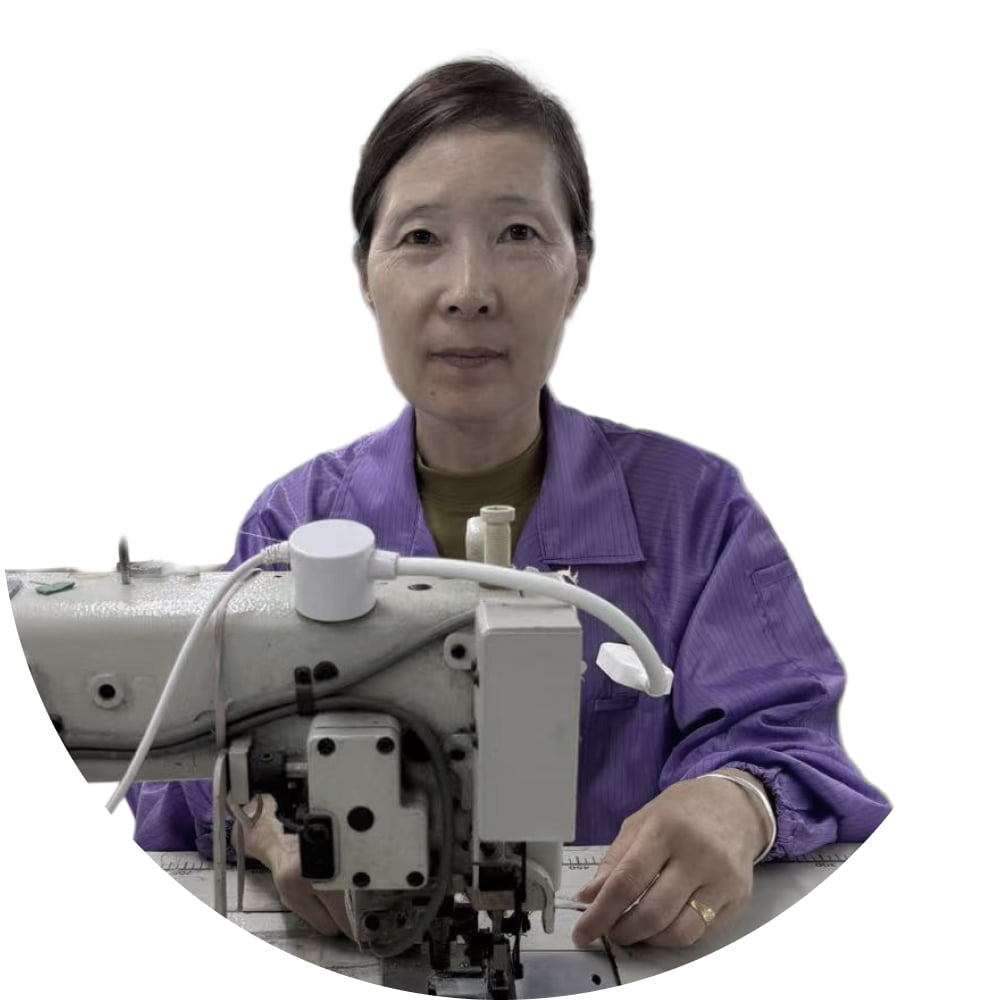
She has done the work herself, at every level.
30 years in the industry.
10 years at PassionWorks.
Nothing moves forward without her sign-off.
Quality. Efficiency. Delivery.
Three things that have to work together.
Fenglan makes sure they do.
When a detail is wrong,
it is not just a production error.
It is a broken promise.
That is not something she is willing to accept.
Which is why nothing gets past her.
This is not a checklist exercise. Quality is the foundation of trust with every client. When a detail is wrong, it is not just a production error. It is a broken promise. That is not something we, and Fenglan, are willing to accept.
